Mental Toughness in Soccer: Why Talented Players Hesitate, Hide, and Quit (And What Fixes It)
About the Author: Alex Bolowich is a Certified Mental Performance Consultant, founder of Elite Mental Performance and Co-Founder of Ibex Tactics. Alex is based out of Charlotte, North Carolina, where he specializes in working with athletes and teams to help them perform in the most intense situations, building practices for sustained excellence at elite levels like the NCAA, NFL, MLS, NBA, and Olympics. If you are interested in any of his signature programs, use the link here! Enjoy the article below!
Mental Toughness in Soccer: Why Talented Players Hesitate, Hide, and Quit (And What Actually Fixes It)
You know the player. Talented in training. Then game day comes and something is off. They stop checking to the ball. They refuse the 1v1 duels. They pass instead of shoot. They hide behind players, and they don’t give all the effort that they’re capable of giving.
The coach says the line every soccer player has heard a thousand times: “Be mentally tough... Don’t worry about mistakes... You’re playing not to lose instead of playing to win.”
The instruction is not wrong. It is useless, because the part of the brain that follows instructions has already clocked out by a different part of the brain.
Most conversations about mental toughness in soccer never get this far. They stay on the surface, repeating feel-good content that sounds good and changes nothing. We are going underneath it, into the nervous system that decides, long before your athlete does, whether their talent shows up or stays home.
Why Do Your Players Hesitate On The Field?
On the surface, the problem looks like behavior. Holding back from taking chances. Avoiding 1v1s. Not pulling the trigger on a shot. Not even moving off the ball to get open, because getting open means getting the ball, and getting the ball means a decision that could go wrong in front of everyone.
That last part is the whole thing. The fear is not really about the mistake. The fear is about what the mistake means. What the teammates think. What the coach thinks. The scout in the stands. The friends who came to watch. The parents on the sideline. That is the engine running underneath every hesitation, and it is not a character flaw. It is social evaluation, and the brain treats it like a genuine threat.
This is not soft speculation. When researchers systematically reviewed why kids leave organized sport, the strongest drivers were interpersonal and social pressures along with perceptions of competence, and soccer was one of the most-studied sports in the entire review (Crane & Temple, 2015). Translation: kids do not mostly quit because “they burnout.” They quit because of how the experience makes them feel about themselves in front of other people. And then they burnout from that.
The Hesitation Scale: There Are Levels to This
Not every hesitating player is in the same place. I use a simple 1-to-5 scale to map where an athlete actually is, because "lacks confidence" is too lazy to be useful.
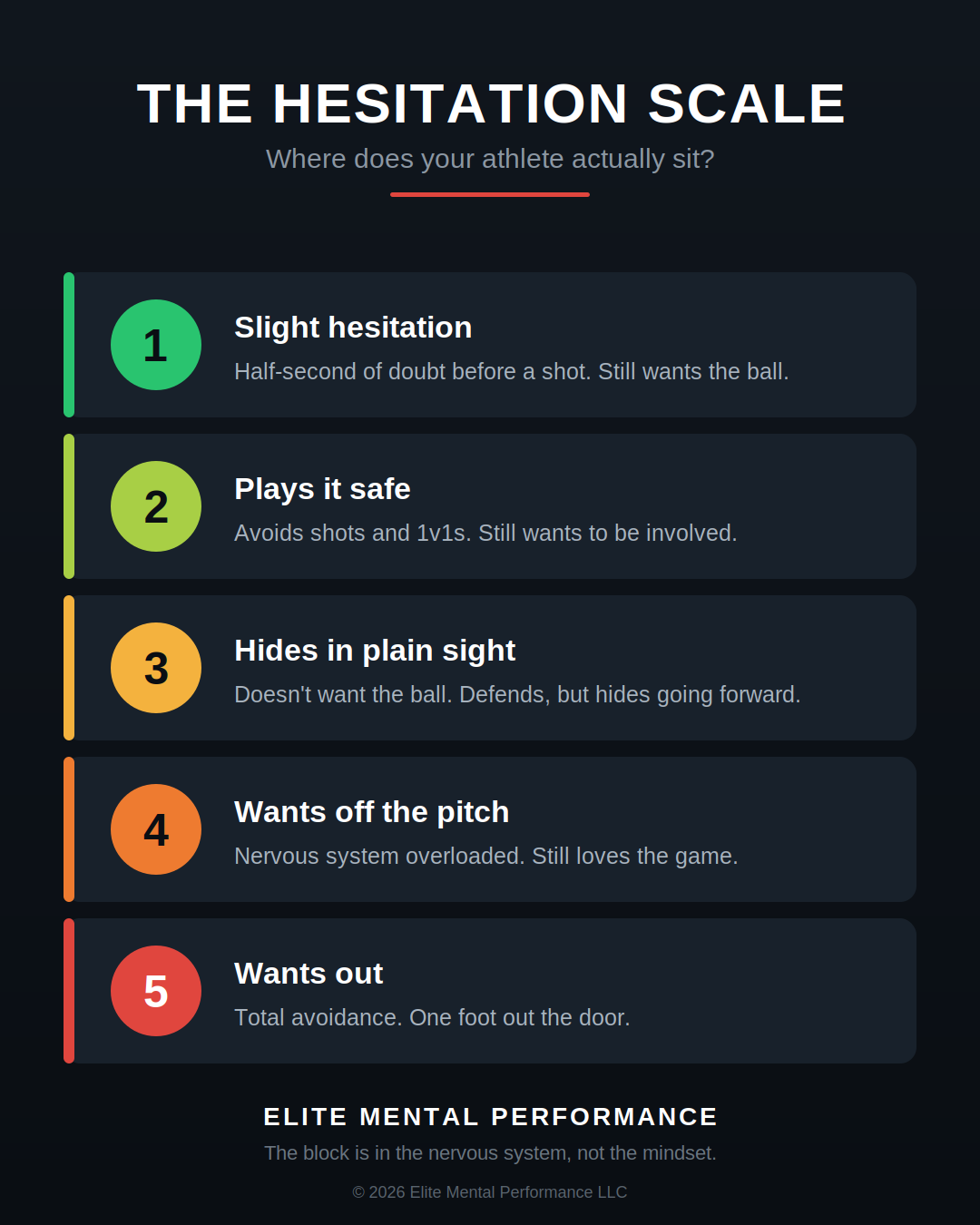
Level 1 is slight avoidance. The micro-hesitation before a pass or a shot. They still play, they still want the ball, but a flicker of doubt costs them a half-step. This can typically be attributed to complex decision making and evaluating the best option between pass dribble or shoot.
Level 2 is avoiding shots and risk-taking with the ball at their feet. They still want involvement, but the moment the play demands courage they recycle it sideways. This is where we might be able to solve it with “mindset” work.
Level 3 is not wanting the ball, but still wanting to be on the field. These players get real enjoyment from contributing defensively, tracking back, doing the dirty work. Offensively, they hide behind opponents. You have 11 players on defense but 10 on offense. Good sign this is beyond their mindset and starting to creep into the nervous system.
Level 4 is not even wanting to be on the field. The nervous system is that overloaded. The difference is they still love the sport. The body just will not let them step into the arena without flooding.
Level 5 is they want out. Total avoidance. Quitting.
The behaviors change by position, but the scale does not. A striker hides by drifting where the ball will not find them. A goalkeeper hides by staying glued to the line instead of commanding the box, waving at a cross instead of attacking it.
Here is why that scale matters. The widely circulated figure is that roughly 70 percent of kids drop out of organized sport by around age 13. That exact number gets debated, and honestly it should, the data behind it is messier than the headline suggests. But the direction is not in dispute: participation drops off a cliff through early adolescence, and soccer gets hit hard (Crane & Temple, 2015). A lot of those 5s did not lose their ability. They lost their regulation. And nobody noticed them sliding from a 2 to a 3 to a 4 until they were already gone.
Why "Just Be Tougher" Fails: The Neurobiology Nobody Explains
Most coaches and parents point to mindset and mental toughness. The intention is good. The problem is they rarely understand how pointless that approach becomes once an athlete's nervous system is tapped out. You cannot mindset your way out of a deep physiological state and here’s why.
The Window of Tolerance
Every athlete has a stress threshold, sometimes called the window of tolerance, a term the psychiatrist Dan Siegel popularized. Inside that window, you can think, choose, read the game, and execute. You are in a voluntary state, running the show from the rational, planning part of your brain. Push the stress past the threshold and you fall out of that window into a survival state. Now you are involuntary. The body is driving and the conscious athlete is a passenger.
Picture a goalkeeper inside her window. A cross comes in and she reads it early, calls it, attacks the ball at its highest point, and claims it. Same keeper, same cross, but now shove her outside her window. She freezes on her line, flat-footed, hoping that someone else can bail her out. The skill is still present but the ability to access the skill changed.
When the Amygdala Wins
Here is the part that changes everything. Your prefrontal cortex is the slow, smart, deliberate part of the brain. It handles decisions, composure, and skilled execution. Your amygdala is the fast, ancient alarm system. Under stress, these two are in a tug-of-war, and the amygdala often wins depending on intensity.
Researchers have shown that even mild, uncontrollable stress floods the prefrontal cortex with stress chemistry that rapidly weakens it, while simultaneously strengthening the more primitive, reflexive circuits run by the amygdala (Arnsten, 2009). Stress does not just distract the smart brain. It chemically takes it offline and hands the keys to the alarm system. That is the neurobiological proof that the limbic center (subconscious) overrides "mindset." You are not weak, you just lost conscious control.
The Chemistry: Hypothalamus to Adrenals
When the alarm fires, the hypothalamus signals down a chain to the adrenal glands, which dump adrenaline and cortisol into your bloodstream. Heart rate spikes. Muscles tense. Vision narrows. This is brilliant engineering if a bear is chasing you. It is a catastrophe if you are trying to thread a disguised through ball with composure. Your autonomic nervous system has decided this is life or death, and it is allocating resources accordingly.
This Is Why Practice Does Not Transfer
This is also why the practice-to-game gap exists, and why so much of mental toughness in soccer comes down to neurobiology rather than attitude. In training, the threat is low, the smart brain is online, and skill runs on autopilot. Under real pressure, that automatic execution breaks down. Research on choking shows exactly this: pressure disrupts the smooth, automatic performance of skills the athlete has already mastered (Beilock & Carr, 2001).
This is also measurable. Biofeedback tools can measure heart rate variability and give you a real window into where an athlete's nervous system stress tolerance levels are at. What you can measure, you can improve.
How Did We Get Here? We Remember Emotional Moments
Nobody is born hesitating. This builds. It is an accumulation of chronic stress, the slow drip, plus a few hits of acute stress, the big spikes.
The slow drip is the car ride home, the one where a well-meaning parent dissects every touch and the kid learns that their performance decides whether the people they love are happy with them. The big spikes are things like a serious injury, or a coach embarrassing them in front of the entire team at the exact moment the stakes felt highest.
These are not just events. They are emotional experiences, and that distinction is critical. We do not really remember moments. We remember emotional moments. Memory and emotion are wired together, which is why a single humiliating substitution at age 12 can still be calling the shots at age 17. The body keeps the score (Van Der Kolk, 2015).
And here is the kicker. If an athlete never down-regulates after those experiences, if they stay parked in a low-grade fight-or-flight state, the system does not just stay stuck. Over time it defaults to something quieter and more dangerous: the freeze response. That is what you are watching on the field.
What Shows Up on the Field: Flight, Freeze, and Fawn
Once you understand the survival states, the hesitation stops looking like weakness and starts looking like a nervous system doing the wrong job.
The flight response is the player who avoids getting on the ball, or avoids getting on the field at all. Distance equals safety.
The freeze response is the hesitation itself. The moment a risk appears, a chance to shoot, a 1v1, the body locks up for a half-second. That half-second is the difference between elite and average.
The fawn response, as we tend to see it play out, looks like complete submission. Going through the motions, throwing in the towel, quitting. It is the body's version of "please stop, I am done fighting." To be clear, that is how it shows up to a mental coach on the touchline. It is an observation, not a hard scientific claim.
None of these are the athletes being soft. They are protective programs. Your nervous system is solving a survival problem when the actual problem is a soccer problem.
What We Actually Want: Fight or Flow
So what is the goal? We want to flip the athlete out of flight, freeze, and fawn into one of two states that actually win games: fight or flow. Both share the one quality hesitation lacks. They lean in instead of away.
Flow is the holy grail. Lower perceived effort, time distortion, a near out-of-body sense of ease, and a hyper-present focus where the game just happens through you (Csikszentmihalyi, 1990). It feels effortless because the smart brain stops interfering.
Fight is the grittier cousin. More tension, more edge, fueled by competitive fire, by anger pointed in the right direction, by a focus on beating the opponent in front of you and the taste of triumph. It does not feel effortless. It feels like a war you intend to win.
We are going to go deep on flow in a separate piece. [LINK: insert flow blog title and URL here] For the rest of this one, we are building the fight response, because for most hesitating players, fight is the bridge out of freeze.
How to Build the Fight Response
Train the Emotion: Controlled Aggression, Not Cheerleading
First, kill the idea that generic positive self-talk fixes this. "You got this, stay positive, believe in yourself" is the participation trophy of mental performance. It is not that self-talk does not work. Self-talk is a reliably effective choice we have, with research showing a solid positive effect on performance across dozens of studies (Hatzigeorgiadis et al., 2011).
The catch is that content and intent are everything, and that meta-analysis found the effect was even stronger for the fine-motor, precision tasks soccer is full of.
The dialogue has to call controlled aggression out of them. This is the chip on the shoulder. The "I was doubted, I was overlooked, I failed last time and I refuse to feel that again" story. Cristiano Ronaldo has spent two decades turning every critic and every "he is finished" into fuel, manufacturing a reason to prove someone wrong long after he had nothing left to prove. That is not arrogance for its own sake. That is a nervous system being deliberately fed a story that produces fuel instead of fear.
Keep It Controlled, or It Backfires
Now the word that does all the work: controlled. Aggression without a leash is just a different way to lose.
Crank it too high and you split your attention. Suddenly you are focused on the opponent, the referee, the media, and not on the actual task in front of you. That is how a mentally strong competitor turns into a player sent off for a red card.
Push emotion even higher and the chemistry we talked about turns on you: too much adrenaline floods your muscles with tension, and tension is the enemy of accuracy, reaction speed, and timing. There is a sweet spot for arousal (emotion), and past it, performance falls off a cliff. The goal is fire with a thermostat, not a wildfire.
Regulate the System: Breathwork and a Visual Reset
Here is the practical conditioning piece, and it is simpler than the science sounds.
Your breath is a direct line to your vagus nerve, the main brake cable of your parasympathetic nervous system. This is the heart of Stephen Porges's polyvagal theory: the vagus is the wiring that tells your body whether it is safe enough to perform or whether it should be bracing for a threat (Porges, 2011). The lever is the exhale. The longer your exhale relative to your inhale, the harder you press that brake.
Use diaphragmatic breathing on a 4-count inhale and an 8-count exhale, ten minutes a day. Not just before games. Daily. You are not trying to relax in the moment, you are widening the window so game-day stress has further to climb before it tips you out. Breathe from the belly, not the chest, because chest breathing is what a stressed body already does on its own.
A visual tool before competition has been helpful. Two to three minutes of vergence. You switch gazes between two objects on the same line of fixation, but one object is closer in proximity and the other is further away just behind it.
Where your eyes settle is not neutral. The position of your gaze is tied directly to limbic activation, which is the basis of David Grand's work on the visual field and the nervous system (Grand, 2013). A short, deliberate eye routine before warmups gives the system a physical off-ramp out of spin mode and into focus.
Reward the Process, Not the Result
Last piece, and it is the one most coaches skip. When an athlete is climbing back from a 3 or a 4, do not make the first goal "score" or "win the cross." Make the goal the act of overcoming the hesitation itself. Did you come off your line when every instinct said stay? Did you take the shot instead of recycling it sideways? That is the rep that counts, and that is what gets rewarded, before we ever grade the outcome.
This matters neurologically. You are teaching the nervous system that stepping into the risk is safe, that the sky did not fall. Reward the courage first and the execution follows. Reward only results, and you just hand a struggling athlete one more thing to be afraid of.
I’ve seen this with club players in Charlotte and all over North Carolina. They’re chasing a chance to compete in the NCAA. And the truth is North Carolina does not lack talent. There is an abundance of it. But we lack the understanding of the nervous system and it’s role in performance and because of that, all the potential is being left untapped.
What This Looks Like in Real Life: A Goalkeeper Named Maya
Let me make this concrete. I once worked with a goalkeeper I will call Maya (to protect her confidentiality) from Arlington Virginia. Seventeen, genuinely talented, getting recruited to an ACC school, but quietly coming apart. In training she was composed and brave. In games she started overthinking, lost the feel of her own body, and hesitated on the exact actions a keeper cannot hesitate on: coming for crosses, coming off her line, closing down an attacker in a 1v1. Her performance dropped and she could not understand why. She had put in thousands of hours. On paper she had earned better.
The advice she got was the advice everyone gets. "Don't worry about it." "Focus on the next play." As if the brain were a light switch you flip on command. If only it were that easy. Her entire mental game was a series of predictable steps, and not one of them started in the part of the brain where "mindset" lives. By the scale above she was sitting around a 3 and sliding toward a 4: still desperate to be out there, but hiding from the brave actions that define the position.
Here is what we actually did. Before practices and games she ran diaphragmatic breathwork, a 4-count inhale and an 8-count exhale for ten minutes, plus two to three minutes of vergence work to settle her nervous system.
In our sessions we did the part nobody had done with her. We uncoupled where the block was actually originating, traced it back to the emotional moments that installed it, and then mentally rehearsed working with the block in real time instead of waiting for it to disappear. She did not need to feel zero fear. She needed to learn to attack the cross while the fear was still talking.
It took roughly fourteen sessions across six months. Not a weekend. Not a hype speech. There is no magic pill for this, and anyone who tells you otherwise is unethical in doing so. But the keeper who used to wave at crosses started commanding her box again, because we rebuilt the system underneath the skill instead of just demanding she be tougher.
The Reframe: Stop Asking Them to Be Tougher
Here is the challenge, and it is for coaches, parents, and athletes alike.
Stop asking the player to be more mentally tough as if toughness were a switch they are refusing to flip. Start asking a better question: can their nervous system even access "tough" right now?
Gritting harder while the prefrontal cortex is offline does not build mental strength. In fact it can set it back even more. It teaches the body that the field is a dangerous place, one rep at a time, and that is how a 2 becomes a 5.
Real mental toughness in soccer is not white-knuckling your way through a fried nervous system. It is building one that does not fry in the first place, then learning to lean in when it matters. So the next time you feel yourself hesitate, do not just grind harder. Notice where you are on the scale. Regulate. Then compete.
The hesitation is not who you are. It is a state you got trained into, which means it is a state you can train your way out of.
If you want a personalized plan to map your athlete's hesitation scale, measure their stress threshold, and build a fight-or-flow response that transfers from practice to games, book a consultation to see if my skillsets will help your player. Let's get that talent out of training and onto the field.
References
Arnsten, A. F. T. (2009). Stress signalling pathways that impair prefrontal cortex structure and function. Nature Reviews Neuroscience, 10(6), 410-422.
Beilock, S. L., & Carr, T. H. (2001). On the fragility of skilled performance: What governs choking under pressure? Journal of Experimental Psychology: General, 130(4), 701-725.
Crane, J., & Temple, V. (2015). A systematic review of dropout from organized sport among children and youth. European Physical Education Review, 21(1), 114-131.
Csikszentmihalyi, M. (1990). Flow: The psychology of optimal experience. Harper & Row.
Grand, D. (2013). Brainspotting: The revolutionary new therapy for rapid and effective change. Sounds True.
Hatzigeorgiadis, A., Zourbanos, N., Galanis, E., & Theodorakis, Y. (2011). Self-talk and sports performance: A meta-analysis. Perspectives on Psychological Science, 6(4), 348-356.
Porges, S. W. (2011). The polyvagal theory: Neurophysiological foundations of emotions, attachment, communication, and self-regulation. W. W. Norton.
Van der Kolk, B. A. (2014). The body keeps the score: Brain, mind, and body in the healing of trauma. Viking.
